
5 Takeaways from When Information is Mutual Aid
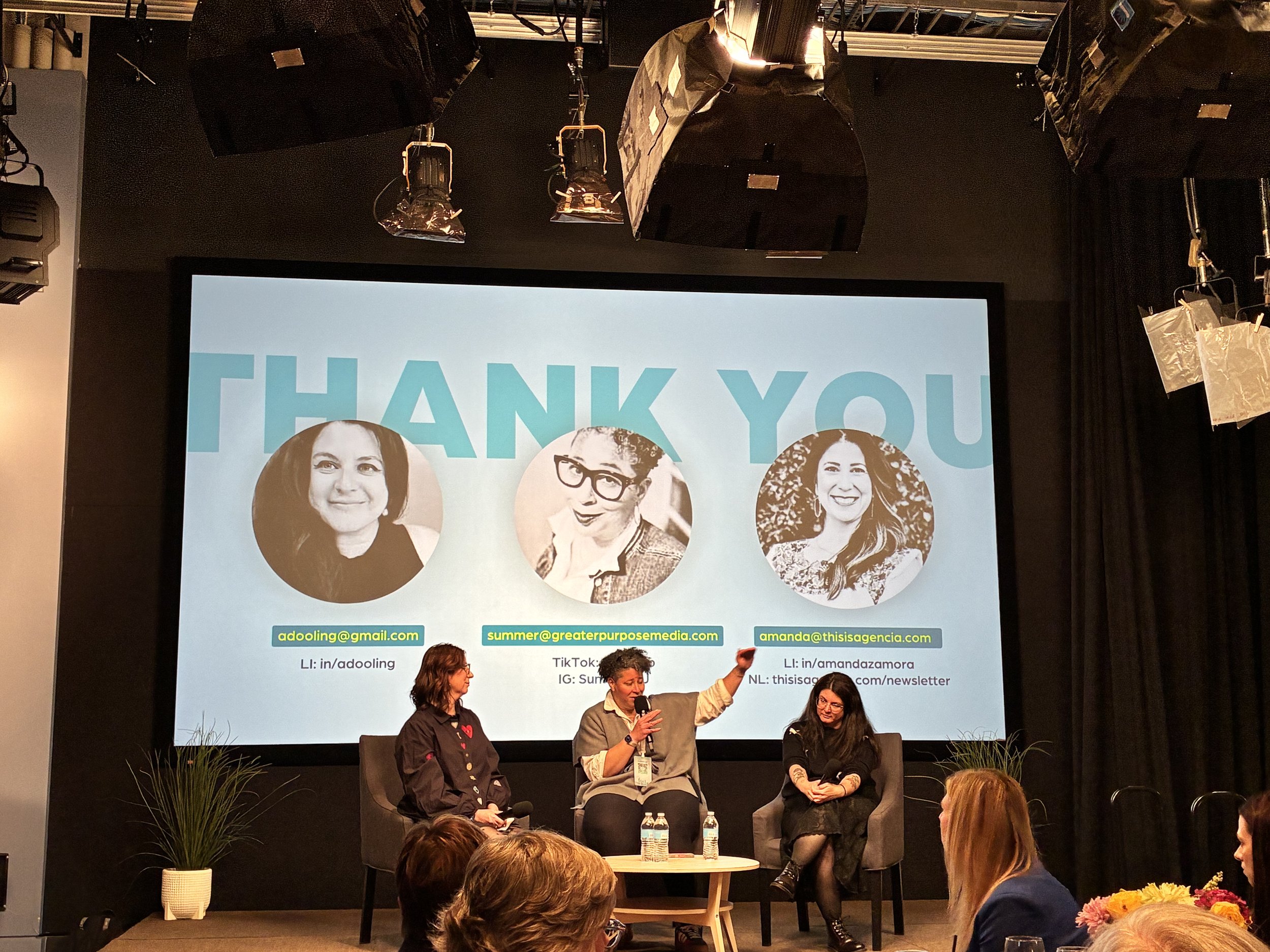
Collaborative Journalism Summit, Philadelphia — May 14, 2026
Annemarie Dooling runs The Platia, an independent, Philadelphia-based outlet embedded in mutual aid networks across the city. Summer Nettles is an advocacy journalist and documentary filmmaker behind Greater Purpose Media in Denver. I moderated their conversation at the Collaborative Journalism Summit on May 14.
1. Meet the people before you meet the story.
Distrust in news is at a recorded high — and coverage that reduces communities to incidents, statistics or crises is a significant part of why. The Reuters Institute's 2026 Digital News Report finds that trust in news has fallen to its lowest point since tracking began in 2015, driven in part by audiences who feel journalism happens about them rather than with them. Annemarie described an encampment in South Philly where people were refusing shelter because it meant being split from their dogs and their families — they had been covered in the local press. And they didn't like how they were being portrayed. Annemarie's read on what went wrong:
"I think it would behoove all of us as journalists to go meet the people before we meet the story — to really think about who we're talking about before we just go out and say, here's this crazy story happening over here. But like, who actually are those people?"
2. Ask whether you're helping materially, not just informationally.
The open rate on a newsletter is a metric. An 85% open rate on a newsletter of volunteer opportunities is a signal. There's a difference — one tells you people are opening, the other tells you people needed it. Annemarie didn't set out to build a newsletter. She was doing NARCAN trainings, food distribution and CPR workshops. People started asking her to write things down.
"I think we need to really inspect: if we are here to make people's lives better, if we are here to elevate our communities — are we doing that materially, or are we doing that with articles, and then forgetting them five days later?"
Her words on how the newsletter happened:
"I really thought I had left [writing the news] behind... And people kept asking for things... It shows that I know nothing, and you should always ask your audience what they actually want."
3. In crisis, lower your voice.
More than 4 in 10 people globally say they often or sometimes avoid the news — up from 29% in 2017, according to the Reuters Institute's 2026 Digital News Report — and alarm-driven coverage is a documented driver of that avoidance. Summer spent years in broadcast — radio, local TV, the whole anchor-delivery apparatus. She made a conscious break from it when she shifted to independent journalism.
"I open with 'Hi friends, hi family.' And that's because I am talking to my friends. I am talking to my family... [T]hat stodgy delivery that we've been trained to execute does not reach the hearts of your audience."
And when a story breaks? Communities are wary of journalists showing up to a crisis with camera lights and recorders rolling. Our jobs are bigger than just recording the facts — and more specific than just turning down the volume.
"Our job is to... turn[ down] the volume... Our job is to make that information available to people. It's not to exacerbate the situation."
Summer's framing: be the neighbor with the cup of tea. While the house is on fire, your job isn't to perform the crisis — it's to say here's who to call, here's what comes next. Pressing the panic button leads to freeze, not fight.
4. Your presence is information, too.
Newsrooms have long treated the reporter's identity as something to sideline in service of objectivity. The communities that trust journalism least tend to be the ones that have seen what that posture actually produces — coverage that claims neutrality while centering power.
Summer was the only Black woman at a mayoral briefing on evictions in Denver. That absence — of perspective, of proximity, of accountability — is itself a story. Instead of hiding it, she named it:
"I am the only Black woman here, and I'm here to talk about the fact that Black women in Denver get evicted at twice the rate of white women. I'm here to tell you that the average age of an evictee in the United States is four years old, and that we are evicting 1,200 people a month in Denver. And I'm asking you what you're going to do about it."
Who's in the room — and who isn't — shapes what gets asked, what gets recorded, and what makes it into print. Proximity to a community doesn't compromise your reporting. It's what makes certain reporting possible at all.
5. Engagement is a practice, not a program.
Publishers who invest in direct audience relationships — built through first-party data, community access and distinctive reporting — are better positioned to build loyalty beyond transactional subscriptions. But both Annemarie and Summer pushed back on the idea that community-first journalism requires special infrastructure to get started. Summer's framework was clear:
"Engage, communicate and activate. And that means that you're going to where the community you serve is ... be at the jazz club, be at the poetry slam, be at the father-daughter dance, be at the city council meeting — and then go out with the person who cried because of their frustrations and talk with them. Don't just stay there to ask the council people."
Annemarie's version was just as direct:
"I think about all the time I spent making spreadsheets and sitting at my desk instead of actually humanizing the stories that I was writing... There's people out there living who want to talk to you."
This post is based on a transcript of a conversation during Day 1 of the Collaborative Journalism Summit, Philadelphia, May 14, 2026.
